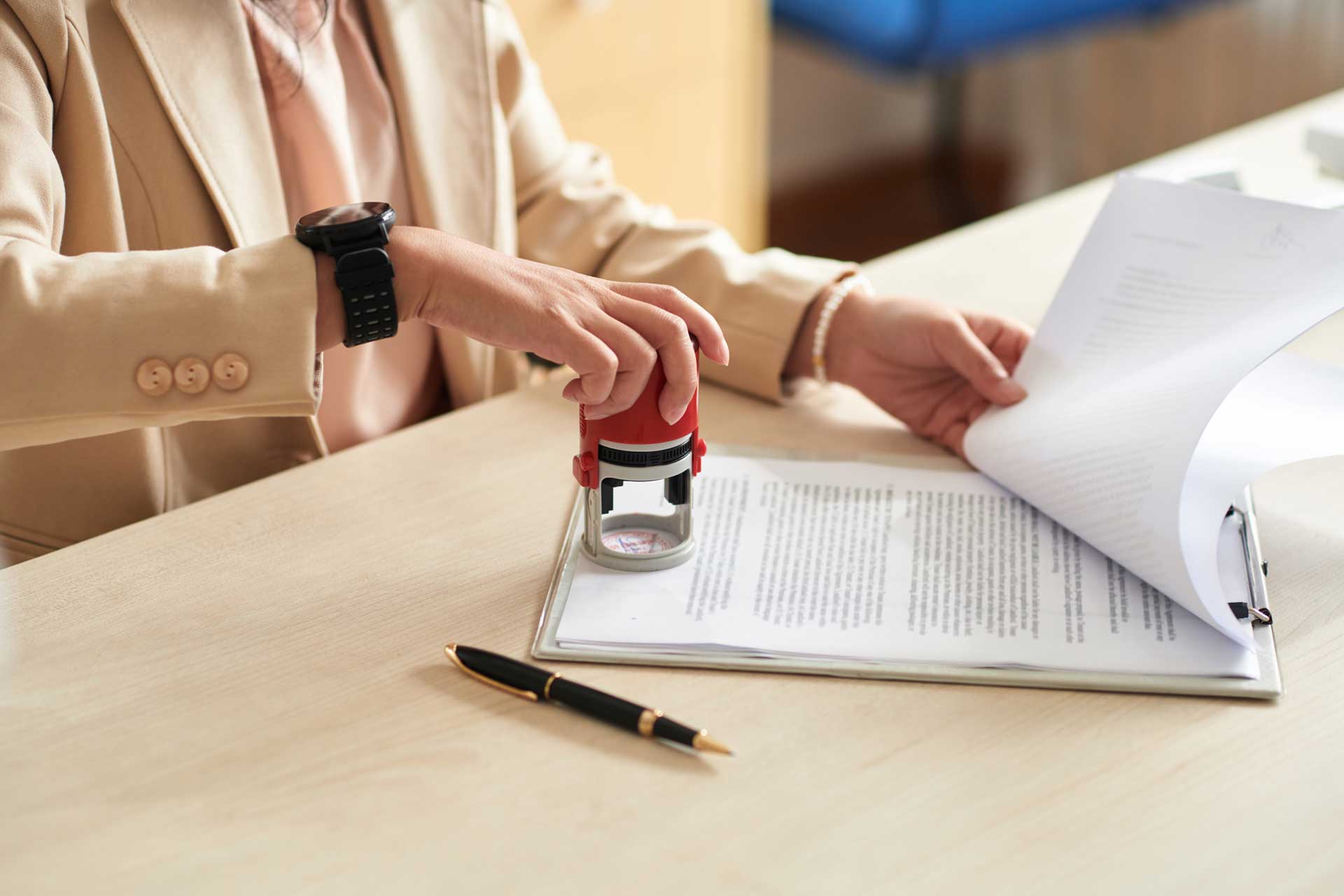
Serving as a notary public in Alabama carries both responsibility and authority. One of the most essential tools in a notary’s practice is the official seal or stamp, which authenticates every act they perform. Below is a comprehensive breakdown of Alabama’s notary stamp and seal requirements, why they matter, and how notaries can stay compliant.
Legal Requirement for Seals in Alabama
Alabama law requires all notaries public to provide and use an official seal. This seal must be affixed to authenticate each official act, ensuring that the notarial act is legally recognized and trusted.
Without the official seal, a notarization may be considered invalid, putting both the notary and the parties relying on the document at risk.
Statutory Breakdown
According to Alabama’s statutory requirements, every commissioned notary must maintain a seal of office. The law specifies that this seal must present, through its impression:
- The name of the notary
- The office held (Notary Public)
- The state of Alabama for which they were appointed
Stamp-Article-Resource
This ensures clarity, uniformity, and accountability across all notarizations performed within the state.
Design & Format Requirements
While Alabama law mandates the use of a seal, it leaves room for flexibility in design and format. Common practices and best standards include:
- Shape: Circular or rectangular designs are widely used.
- Content: Must clearly display the notary’s name, title (“Notary Public”), and the state (“Alabama”).
- Size: Though not strictly limited, stamps are typically no larger than 2 inches in diameter (for circular) or 1” x 2.5” (for rectangular) to ensure legibility.
- Ink: Black ink is the standard because it is photographically reproducible and widely accepted for official documents.
- Embossers: While an embosser may be used for stylistic or traditional purposes, it should not replace the official inked stamp, which is necessary for reproduction and official acceptance.
Special Notes & Considerations
Beyond the basic requirements, Alabama notaries should be aware of additional guidelines that govern the use and maintenance of seals. These considerations address modern practices, security concerns, and the historical evolution of notarial tools. Understanding them helps notaries remain both compliant and effective in their professional role.
Electronic Seals
As Alabama modernizes notarial practices, electronic seals are increasingly recognized in certain contexts. An electronic seal must still replicate the required identifying elements (name, title, state) and be securely applied in a way that prevents alteration.
Replacement or Security of Seals
The seal is the exclusive property of the notary. It must never be shared or surrendered, even to an employer. If a notary’s credentials are lost, stolen, or damaged, they should promptly notify the appropriate authorities and obtain a replacement to prevent potential misuse.
Historical Context
While embossers were once the standard, modern practice now prioritizes rubber stamp seals in indelible ink to meet today’s document reproduction and electronic filing needs.
Why the Seal Matters
The notary seal is more than a formality; it is the mark of authenticity. Its presence confirms that:
- The notary was duly commissioned in Alabama.
- The act was performed under lawful authority.
- The document will be accepted by courts, government offices, and other institutions requiring notarization.
Failure to affix a proper seal can lead to rejected documents, delayed transactions, or legal challenges. For the notary, it may result in disciplinary action or liability.
Best Practices for Compliance
To ensure smooth and compliant notarial work, Alabama notaries should follow these best practices:
- Invest in a high-quality seal. A durable stamp prevents smudging and ensures every impression is legible.
- Use only black ink. While colored inks may seem appealing, black is the professional standard, ensuring photographic reproducibility.
- Keep the seal secure. Store the stamp in a locked area accessible only to you.
- Do not pre-stamp documents. Always affix the seal only at the time of notarization.
- Regularly inspect your seal. Replace it if impressions become faint or unclear.
- Stay current with laws. Periodically review Alabama notary regulations to ensure no new changes affect your responsibilities.
Alabama notaries should invest in a reliable, state-approved notary stamp to maintain compliance.
Importance of Compliance with Alabama Law!
In Alabama, the notary seal is a symbol of both trust and authority. It guarantees that notarized documents are properly authenticated and accepted by institutions across the state and beyond. By adhering to Alabama’s requirements, maintaining the security of their seals, and practicing consistent diligence, notaries can protect themselves legally while serving the public with integrity.
For long-term reliability and professional presentation, every Alabama notary should upgrade to a durable notary stamp and seal set.